Posts

Evidence-based Model:Your New HR Brand is Here!

Image
I t is out there: many claim the new evidence-, competency-based HR model, the all new HR look, feel and sign of recognition. I t has generated a lot of waves in the HR community. The general feeling was one of disbelief, if not outrage. How did this happen? I had a previous post on the topic. Aren't we a body of professionals to be recognized under a global umbrella ? Why did SHRM and HRCI split? If we have not experienced it at the personal level, we felt it at the professional one: we all the sudden became members of a dysfunctional family! Did we see it happen? Did our parents organizations see it coming? The results are the same. We have been facing the change for some time now and we had three choices: reject, ignore, or embrace it. The stages of grief are painstaking, but after all, we are professionals. We ARE HR, so we can individually say, "Je suis HR" under the new competency-based model. Was HR FROZEN in Time? S HRM calls the new model the...


COMMUNICATION, SAFETY & WORKPLACE: "Je suis Charlie"

Image
©AR_HRComatrix_SCharlie C ommunication is powerful, today more than ever, with social media . Frontiers are erased . Time elapses. Things and situations take a different dimension. Everything is "here and now ". This week, " Je suis Charlie " has been the most recent and poignant picture of the power of communication. All started and ended in the workplace . Chilling for HR and Safety people. P eople all the over the world spend most of their time at work . The typical workday is about six to eight hours in the the US with the new approach to the notion of full time job . In France it is typically eight hours, with often some flexibility, and despite the official 35 hours a week. . How can we protect workers against unexpected violence since they spend most of their time at work? H R is not about damage control ; it is about proactivity . Disturbingly enough, only 31% of workplaces in the US seem to be proactive in emergency preparedness, acco...

SIMPLY HR or SIMPLY YOU: Smart Evaluation

Image
M eetings, formal or informal, such as going to seminars or crossing each other in hallways and elevators give us a glimpse of faces of HR. Simply HR or simply human? Ready for a smart assessment? H oliday Seasons are busy: we have to evaluate our year, our team, our business, our metrics, in sum ourselves. How did we score for 2014? H appy Season? ©AR_HRComatrix_SimplyHRC ©Ad_HRComatrix_SmimplyHRS Cranky or Shiny You ? H appy Season! W e would like it to be in the face of the world, and for ourselves. Stressful period? Nor only for accountants and CFOs, but also for HR people. We face a different set of challenges during the holidays : employees feel the pressure of the holiday spirit, and we face the implications of the season . S o, yes, you have been busy lately, and stressed out; yet colleagues and employees still expect you to be Simply HR. Simply HR? What does it mean? How about consistency? How about objectivity? How about sound interpre...

HR TRENDS IN THANKSGIVING MODE: HOW DO YOU COMPARE?

Image
T hanksgiving time brings images of friends and family gatherings, in celebration of "good" happenings. In the world of HR new challenges and regulations have brought a wave of changes. How about a quick snapshot of some new trends in HR that ought to bring us thoughts of HR in Thanksgiving mode? M y latest posts were about workplace balance . Overrated? Maybe. See for yourself the general view on the state of  work/life balance ("home, work, and community obligations") . Nevertheless, it is not uncommon to find many HR people appearing to be so unsure about the direction to take when it comes to building internal policies. Here are some HR goodies. See how you do compare or what stand seems attractive to you. SMALL VERSUS LARGE ORGANIZATIONS Defining the 2014 National Study of  Employers of the Families and Work Institute (FWI) data: Small organizations are those of 50 to 99 employees. Large organizations are those totaling 1,000 employees and ...

WORK LIFE / BALANCE DEBATE- PART II: The Five TOPS by Regions, Countries, Companies and Jobs -

Image
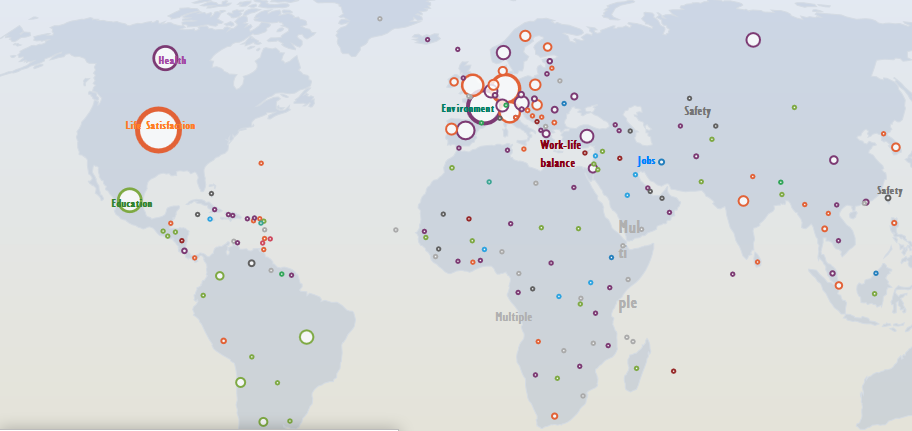
The FIVE MOST IMPORTANT ISSUES BY REGIONS and COUNTRIES I t is educating to see the Organization for Economic Cooperation and Development (OECD)  map of better life index . The assessment of better life varies by regions and by countries, from life satisfaction to safety through education and environment. OECD better life index responses - 2014 Interesting enough, Health is primary in France, Canada, Australia, the Russian Federation,  and Norway. Life-Work balance is important in Mauritius Island, Mali, Montenegro and Nicaragua. Life Satisfaction prevails in US, Germany, UK, as well as Croatia, Poland and Sweden and Finland. Safety is paramount in Japan, Venezuela, Kazakhstan, and The Bahamas. Education is important in Mexico, Brazil, Chile and Argentina The FIVE TOP COMPANIES According to Glassdoor, there are 25 companies that are rated to be the best in work/life balance policies. Employees do love it. Those organizations include non-profit, as w...

WORK LIFE / BALANCE DEBATE - Part I: A BUSINESS, A HR, OR PERSONAL CHOICE?

Image
W ork/Life balance exists and is possible for privileged functions. It is undeniably  accessible at both ends of the spectrum: high- and low-end positions, and globally, to a certain extent. The difference is in income stability and real choices . Is work/life balance just empty words or an intellectual speech for some of us? In a SHRM article, it is defined as a myth . So true, it is a matter of priorities. ACC Report- 2014 (on In-House Counsels) TOUCH: THREE ASPECTS OF WORK/LIFE BALANCE   Until you know first hand through one way or another about a specific subject, it is just talk, intellectualized talk. If you have ever been in a French environment, you would know about dwelling into that intellectual talk . Somehow inexplicably satisfying.  So, flexibility, let's talk about it, really: you have to touch and feel it. Then you would be able to say that you know it, from an individual standpoint. There are three major faces of Work/Life Balance. 1- Work/...

CULTURAL DIFFERENCES: ONLY FOR GLOBAL COMPANIES?

Image
T alking about cultural differences is almost vain words until you see the palpable consequences of failed communication . Communication is about getting through your interlocutor. Think Ebola.   www.dailymail.co.uk In general we will agree that the Ebola virus disease (EVD) is not quite understood yet. In practice, there are trends that counteract common sense. Those can be cultural and/or more or less ideological . The major hurdle is getting needed - in this case vital - communication through, as well as timely talent acuisition . This was so unexpected: workers needed !.  Transpose EVD and its impacts on society to a much different and less dramatic scale, and you are encountering global dynamics. Sustainability of multinationals relies a great deal on understanding cultural differences and navigating the cultural and legal, global landscape. UNDERSTANDING ALL FACETS OF CULTURE U nderstanding cultures is essential before implementing any pr...